4 years

Bachelors of Dialysis Therapy Technology (BDTT)

Affiliated to Rajiv Gandhi University of Health Sciences, Bengaluru
Approved by Govt. of Karnataka

COURSE OVERVIEW

The profession of dialysis holds significant importance because it directly impacts the quality of life and survival of individuals with kidney failure. Dialysis is a life-sustaining treatment for people whose kidneys can no longer perform their essential functions of removing waste and excess fluid from the body. Without dialysis, these individuals would face severe health complications and eventual death due to the buildup of toxins and fluid in their bodies.

Dialysis professionals play a critical role in ensuring that patients receive necessary treatments safely and effectively. They monitor patients’ vital signs, adjust treatment parameters, administer medications, and provide education and support to help patients manage their condition. In addition, dialysis professionals often develop close relationships with their patients, offering emotional support and encouragement throughout their treatment journey. This holistic approach to care is vital for addressing the physical, emotional, and psychological needs of individuals undergoing dialysis.

Furthermore, dialysis professionals are instrumental in educating patients about their condition and treatment. Health literacy is particularly important for kidney patients undergoing dialysis, as they must attend treatment sessions several days a week, follow dietary and fluid restrictions, and adhere to complex medication regimens. Ensuring that patients understand and act on complicated health-related information is essential for effective treatment and overall well-being.

About Dialysis Therapy Technology

Dialysis is intended to keep the body functioning as normally as possible while the kidneys are under repair or while a person awaits a kidney transplant. Without functioning kidneys or dialysis, salts and other waste products would accumulate in the blood, leading to poisoning and severe health complications. Typical hemodialysis treatments, which use an artificial kidney, usually last about four hours and are required approximately three times a week.

Over the years, dialysis therapy technology has undergone significant advancements, revolutionizing the treatment of kidney failure and improving patients’ quality of life worldwide. Dialysis encompasses various modalities designed to replicate the functions of healthy kidneys, primarily focusing on the removal of waste products and excess fluids from the bloodstream.

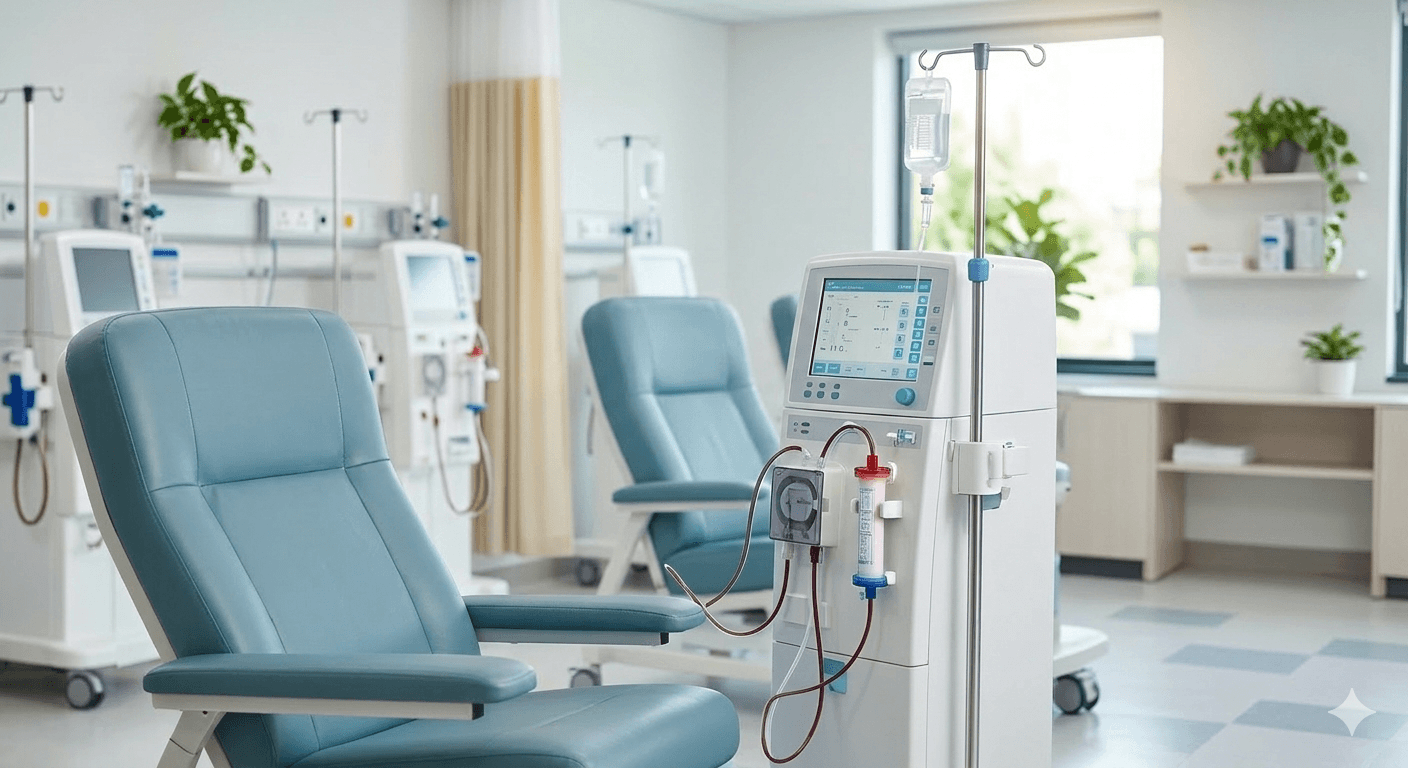
One of the most common forms of dialysis is hemodialysis, in which blood is circulated outside the body through a dialysis machine. Within the machine, the blood passes through a specialized filter called a dialyzer, which removes waste and excess fluid before returning the purified blood to the body. Modern hemodialysis machines have evolved to become more efficient, compact, and user-friendly, featuring automated monitoring systems, touchscreen interfaces, and connectivity for remote monitoring by healthcare providers, ensuring safer and more effective treatment.


Scope of Dialysis Therapy Technology

Dialysis therapy stands as a cornerstone in the treatment of individuals grappling with kidney failure or renal insufficiency. This life-saving procedure is made possible by Dialysis Therapists, whose roles extend beyond the technical administration of dialysis to include holistic care and support that are vital for patients undergoing this demanding treatment.

Dialysis Therapists, also referred to as Dialysis Therapy Technologists, have an extensive scope of practice that highlights their pivotal contributions to the well-being of patients with end-stage renal disease. Their responsibilities include operating dialysis machines, monitoring patient responses, managing complications, and providing education and emotional support to ensure patients adhere to their treatment plans.

The successful delivery of dialysis care relies on the collaborative efforts of a multidisciplinary team. Dialysis Care Associates, Dialysis Therapy Technologists, Dialysis Therapists, and Auxiliary Personnel work together to provide seamless, safe, and effective dialysis treatments, ensuring that patients receive comprehensive care tailored to their physical, emotional, and medical needs.

Duration of the program

  • Duration of the program is 4 years or 8 semesters (inclusive of one year of internship)


ADMISSION TERMS AND CONDITIONS

  • Age Limit: Candidates are typically required to be at least 17 years old by December 31st of the admission year. The maximum age limit for admission shall be 35 years
  • Minimum Educational Qualification

The candidate must have passed Higher Secondary (10+2) or equivalent examination recognized by any Indian Board or a duly constituted Board or National Open School with at least 50% marks in aggregate of physics, chemistry and biology (Botany & Zoology).

Candidates are also eligible from State Open School recognized by state Government and National Institute of Open School (NIOS) recognized by Central Government having Science subject and English only

  • Color blind candidates are eligible provided that color corrective contact lens and spectacles are worn by such candidates
  • Candidates shall be medically fit
  • Married candidates are also eligible for admission
  • Students shall be admitted once in a year
  • Reservation policy:


  • Seats are reserved for candidates belonging to specific categories as follows:

Scheduled Castes (SC): 15% of the total seats.

Scheduled Tribes (ST): 7.5% of the total seats.

  • Other Backward Classes (OBC-NCL): 27% of seats reserved for Non-Creamy Layer candidates, based on the central list.
  • Economically Weaker Section (EWS): 10% of seats are reserved for candidates from the General category with an annual family income of less than ₹8 Lakh.
  • Persons with Disability: 5% horizontal reservation is applicable across all categories (General, EWS, OBC, SC, ST) for candidates with 40% or more benchmark disability

Candidates belonging to SC/ST/OBC (NCL) categories are granted a relaxation of 5% in the minimum aggregate marks required in 10+2 (Physics, Chemistry, Biology).

  • General Category:Minimum 50% in PCB.
  • Reserved Category:Minimum 45% in PCB.


RAGIV GANDHI UNIVERSITY OF HEALTH SCIENCES, BENGALURU (RGUHS)

RGUHS is the affiliating university responsible for setting academic standards, curricula, examinations and overall regulations for Allied health science courses. RGUHS ensures academic quality, regulatory compliance, and degree issuance for BSc. Medical Radiology and Imaging Technology course across Karnataka. All admissions are subject to eligibility conditions of Rajiv Gandhi University of Health Sciences. Eligibility certificate will have to be obtained from Rajiv Gandhi University of Health Sciences, Bangalore.


REQUIRED DOCUMENTS FOR ADMISSION

  • Seven copies of recent photographs (Passport size)
  • The following original certificate shall be retained by the college for issues of University enrolment number:
  1. 10th standard pass certificate for proof of date of birth (Original +3 attested copies)
  2. 12th standard marks card / pass certificate (Original +3 attested copies)
  3. Transfer certificate from the last institute attended
  4. Conduct certificate
  5. Migration certificate from board / university of the institute last studied
  6. Certificate pending to claims of reservations
  7. Eligibility certificate (Non-Karnataka candidates)
  8. Copy of certificate for proof of residence like Aadhar card/ Electricity Bill/ driving License

CURRICULUM OUTLINE

Semester I Medical Terminology and Record Keeping (including anatomical terms)

Professionalism and Values & Indian Constitution

Human Anatomy A

Human Physiology B

Biochemistry C

Introduction to Dialysis Therapy

Human Anatomy (Practicals)

Human Physiology (Practicals)

Biochemistry (Practicals)

Community Orientation and Clinical Visit (CT)

Semester II Pathology

Microbiology

General Pharmacology

Applied Anatomy & Physiology Related to Dialysis Therapy

Fundamentals of Dialysis Therapy

Pathology (Practicals)

Microbiology (Practicals)

Applied Anatomy & Physiology Related to Dialysis Therapy (Practicals)

Fundamentals of Dialysis Therapy (Practicals)

Clinical Postings (CT)


Semester III Sociology in Health Care

Biomedical Waste Management

Pathophysiology of Kidney Diseases

Elective Course (To be chosen by the student)

Instrumentation Specific to Dialysis Therapy

Basic Principles of Nursing Care

Medical Law and Ethics

Instrumentation Specific to Dialysis Therapy (Practicals)

Clinical Postings II (CT)

Semester IV Pharmacology Related to Dialysis Therapy

Psychology

Renal Nutrition

Dialysis Therapies – Part I

Medical Electronics for Health Sciences

Research Methodology and Biostatistics

Pharmacology Related to Dialysis Therapy (Practicals)

Dialysis Therapies – Part I (Practicals)

Clinical Postings III (CT)

Semester V Dialysis Therapies – Part II

Renal Transplantation and Coordination

Clinical Problems and Evidence-Based Practice in Dialysis Therapy

Advanced Extracorporeal Therapies

Elective Course (To be chosen by the student)

Renal Transplantation and Coordination (Practicals)

Advanced Extracorporeal Therapies (Practicals)

Dialysis Therapies – Part II (Practicals)

Clinical Postings IV (CT)


Semester VI Recent Advancements in Renal Replacement Therapies

Principles of Management

Introduction to Quality Assurance in Dialysis and Patient Safety

Basic and Advanced Cardiac Life Support

Elective Course (To be chosen by the student)

Recent Advancements in Renal Replacement Therapies (Practicals)

Basic and Advanced Cardiac Life Support (Practicals)

Clinical Postings V (CT)

Semester VII and VIII Compulsory Internship


Your Pathway to a Rewarding Healthcare Career

Facilities That Foster Excellence for Future Professionals

State-of-the-Art Infrastructure

Well-Equipped Labs and Simulation Centers

Modern Library and Digital Resources

Clinical Training at Renowned Hospitals

Your Path to Success

Why Choose N.E.T Institute of Allied Health Sciences?

N.E.T Institute of Allied Health Sciences stands as a beacon of quality education, equipping students with the knowledge, skills, and compassion required to excel in the healthcare sector. With a focus on academic excellence, hands-on clinical training, and a student-centric learning approach, we ensure our graduates are well-prepared to meet the challenges of the ever-evolving medical field. Choose N.E.T Institute of Allied Health Sciences to embark on a journey of growth, innovation, and service to humanity. Here’s why our institution stands out:

Experienced faculty with clinical expertise

Hands-on training and clinical exposure

Research opportunities and publications

Interdisciplinary collaborations

Placement assistance